RDNA4 WMMA transpose load builtins#
RDNA4 (gfx1200, gfx1201) provides hardware instructions that load a
matrix sub-tile into per-lane VGPRs while transposing row-major and
column-major storage order in the same operation. When a matrix’s storage
order in memory doesn’t match the fragment layout the
RDNA4 dense WMMA builtins expect, these
builtins remove the need for a scalar transpose loop.
Note
Like the WMMA builtins they feed, these load-transpose instructions are
supported only for wave32 on RDNA4. RDNA4 also has wavefrontsize64
transpose-load variants, but since RDNA4 WMMA itself is wave32-only,
those aren’t tied to feeding WMMA and aren’t covered on this page.
Architecture availability#
The builtins on this page target RDNA4 GPUs. To automatically enable them, pass the Low Level Virtual Machine (LLVM) target architecture flag at compile time:
amdclang++ --offload-arch=gfx1200 ...
amdclang++ --offload-arch=gfx1201 ...
Naming convention#
All transpose-load builtins on this page follow the pattern:
__builtin_amdgcn_global_load_tr_b<M>_v<K><type>
Unlike CDNA5’s transpose-load builtins, RDNA4 names carry no bit-width
digit (no tr16/tr8) – RDNA4 has only one transpose-load
instruction family per load size, so no extra digit is needed to
disambiguate it.
MBits loaded per lane (
128or64).KNumber of elements in the return vector.
typeElement type of the return vector:
i32,i16,f16, orbf16.
Register types used in this reference#
The signatures below use the following type aliases, which you can declare with Clang vector attributes in any HIP translation unit:
using v2int   = int      [[clang::ext_vector_type(2)]];
using v8short = short    [[clang::ext_vector_type(8)]];
using v8half  = _Float16 [[clang::ext_vector_type(8)]];
using v8bf16  = __bf16   [[clang::ext_vector_type(8)]];
Note
The f16 builtin requires the __fp16 type (GCC-style
half-precision), not _Float16 (ISO C half-precision). Cast pointers
and vector types to __fp16-based variants at the call site only –
the standard WMMA builtins accept _Float16 as usual. The worked
example below does exactly this with its own half8 alias.
Hardware constraints#
Sub-tile per call, not a full 16x16 tile.
global_load_tr_b128covers an 8-row x 32-column sub-tile per call (see Per-lane fragment layout below) – two calls, the second offset by 8 rows, are needed to fill a full 16-row K-strip. This differs from CDNA5’str16_b128/tr8_b64, which each load a complete \(16 \times 16\) tile in a single call.Wave32 only.
All builtins are
constand have no side effects.
Per-lane fragment layout#
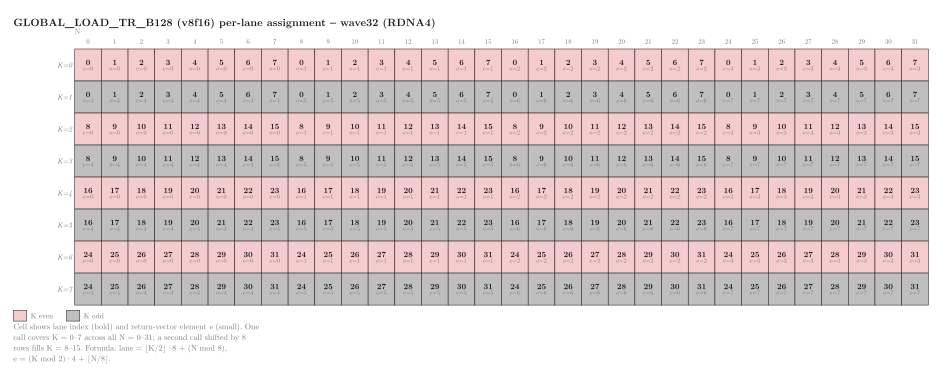
Per-lane assignment for global_load_tr_b128_v8f16. Each cell shows
the lane index (bold) and the return-vector element index \(e\)
(small) that produced it.#
Given a call whose base K-row is k_tile and base N-column is
block_n, lane tx (0–31) reads from:
ptr(tx) = &input[(k_tile + tx/4) * cols + block_n + (tx%4)*8]
and the returned vector’s element e (0–7) lands at:
A second call with ptr shifted by 8 rows (k_tile + 8) fills the
upper half of a 16-row K-strip; together the two calls cover
\(16 \times 32\) elements – exactly the B operand a
wmma_f32_16x16x16_f16_w32_gfx12 K-step needs from two adjacent
wave32 blocks. global_load_tr_b128_v8i16 and _v8bf16 use the same
128-bit data path with a different element-type interpretation, so they
follow this same mapping. global_load_tr_b64_v2i32 uses a different
(64-bit) data path; no per-lane mapping is documented for it below.
Builtin reference#
__builtin_amdgcn_global_load_tr_b64_v2i32#
v2int __builtin_amdgcn_global_load_tr_b64_v2i32(v2int* ptr);
Loads and transposes 64 bits per lane of 8-bit data (INT8, FP8, or BF8),
returning two packed 32-bit words rather than eight discrete 8-bit
elements. This builtin uses a different data path from
global_load_tr_b128; see Per-lane fragment layout.
Parameter |
Type |
Description |
|---|---|---|
|
|
Pointer to global address space. |
Returns v2int – two 32-bit words holding the lane’s 8-bit
fragment after transposition.
__builtin_amdgcn_global_load_tr_b128_v8i16#
v8short __builtin_amdgcn_global_load_tr_b128_v8i16(v8short* ptr);
Loads and transposes 128 bits per lane of INT16 data. Expected to share
v8f16’s permutation – see Per-lane fragment layout.
Parameter |
Type |
Description |
|---|---|---|
|
|
Pointer to global address space. |
Returns v8short – eight INT16 elements holding the lane’s
fragment after transposition.
__builtin_amdgcn_global_load_tr_b128_v8f16#
v8half __builtin_amdgcn_global_load_tr_b128_v8f16(v8half* ptr);
Loads and transposes 128 bits per lane of FP16 data. See the __fp16
note above – cast ptr and the return value to a __fp16-based
v8half at the call site. Its per-lane mapping is detailed in
Per-lane fragment layout.
Parameter |
Type |
Description |
|---|---|---|
|
|
Pointer to global address space. |
Returns v8half – eight FP16 elements holding the lane’s fragment
after transposition.
__builtin_amdgcn_global_load_tr_b128_v8bf16#
v8bf16 __builtin_amdgcn_global_load_tr_b128_v8bf16(v8bf16* ptr);
Loads and transposes 128 bits per lane of BF16 data. Expected to share
v8f16’s permutation – see Per-lane fragment layout.
Parameter |
Type |
Description |
|---|---|---|
|
|
Pointer to global address space. |
Returns v8bf16 – eight BF16 elements holding the lane’s fragment
after transposition.
Using a transpose load as a compute policy#
Using MFMA builtins as a compute policy explains the ComputePolicy/TilePolicy
pattern used to separate tile staging from the compute loop. This section
extends the RDNA4 WMMA FP16 example from
Using WMMA builtins as a compute policy with a transpose-load tile policy.
The complete source file is available for download:
WmmaRdna4F16TrPolicy replaces the scalar B transpose with a hardware-
accelerated GLOBAL_LOAD_TR_B128 instruction
(__builtin_amdgcn_global_load_tr_b128_v8f16). This intrinsic loads 128
bits per lane from global memory and transposes the data into LDS in a
single operation, avoiding the per-element scalar transpose loop. The
per-lane addressing follows exactly the formula in
Per-lane fragment layout.
SingleBufferTilePolicyF16TrB fills B’s shared-memory tile using this
instruction instead of a scalar loop:
template<int BlockTileM_, int BlockTileN_, int KTileSize_>
struct SingleBufferTilePolicyF16TrB
{
    static constexpr int num_buffers  = 1;
    static constexpr int block_tile_m = BlockTileM_;
    static constexpr int block_tile_n = BlockTileN_;
    static constexpr int k_tile_size  = KTileSize_;

    struct SharedStorage
    {
        _Float16 tile_a[BlockTileM_][KTileSize_];
        // B stored transposed: tile_b_T[n][k], same layout as baseline.
        // Filled by global_load_tr hardware scatter from row-major global B.
        _Float16 tile_b_T[BlockTileN_][KTileSize_];
    };

    __device__ static void prologue(SharedStorage& /*smem*/,
                                    const _Float16* /*A*/, const _Float16* /*B*/,
                                    int /*block_row_start*/, int /*block_col_start*/,
                                    int /*m*/, int /*n*/, int /*k*/,
                                    int /*tid*/, int /*num_threads*/) {}

    __device__ static void prefetch(SharedStorage&  smem,
                                    const _Float16* A,
                                    const _Float16* B_row,
                                    int             t_next,
                                    int block_row_start, int block_col_start,
                                    int m, int n, int k,
                                    int tid, int num_threads)
    {
        const int t = t_next;

        cooperative_load_tile_a_f16(
            &smem.tile_a[0][0], A, block_row_start,
            block_tile_m, t, k_tile_size, m, k, tid, num_threads);

#if defined(__gfx1200__) || defined(__gfx1201__)
        using half8 = __attribute__((ext_vector_type(8))) __fp16;

        constexpr int wave_size = 32;
        const int lane_id       = tid % wave_size;
        const int k_tile        = t * k_tile_size;
        const int col_offset    = lane_id % 8;
        const int row_pair_base = (lane_id / 8) * 2;

        // Call 1: lower K-half (k_local = 0..7).
        {
            const __fp16* ptr_b =
                reinterpret_cast<const __fp16*>(
                    &B_row[(k_tile + lane_id / 4) * n
                           + block_col_start + (lane_id % 4) * 8]);
            const half8 tr_lo =
                __builtin_amdgcn_global_load_tr_b128_v8f16(
                    (__attribute__((address_space(1))) half8*)ptr_b);
            #pragma unroll
            for(int e = 0; e < 8; ++e)
            {
                const int n_local = (e % 4) * 8 + col_offset;
                const int k_local = row_pair_base + e / 4;
                smem.tile_b_T[n_local][k_local] = tr_lo[e];
            }
        }

        // Call 2: upper K-half (k_local = 8..15).
        {
            const __fp16* ptr_b =
                reinterpret_cast<const __fp16*>(
                    &B_row[(k_tile + (k_tile_size / 2) + lane_id / 4) * n
                           + block_col_start + (lane_id % 4) * 8]);
            const half8 tr_hi =
                __builtin_amdgcn_global_load_tr_b128_v8f16(
                    (__attribute__((address_space(1))) half8*)ptr_b);
            #pragma unroll
            for(int e = 0; e < 8; ++e)
            {
                const int n_local = (e % 4) * 8 + col_offset;
                const int k_local = (k_tile_size / 2) + row_pair_base + e / 4;
                smem.tile_b_T[n_local][k_local] = tr_hi[e];
            }
        }
#endif
    }

    __device__ static void acquire(int /*t*/) { __syncthreads(); }
    __device__ static void release(int /*t*/) { __syncthreads(); }
    __device__ static int  buf_idx(int /*t*/) { return 0; }

    __device__ static _Float16* get_tile_a(SharedStorage& smem, int /*buf*/)
    {
        return &smem.tile_a[0][0];
    }
    __device__ static _Float16* get_tile_b_T(SharedStorage& smem, int /*buf*/)
    {
        return &smem.tile_b_T[0][0];
    }
};
The compute path (load_a, load_b, mma, store_c) is
identical to the baseline WmmaRdna4F16Policy – only the tile policy’s
prefetch() stage changes:
struct WmmaRdna4F16TrPolicy
{
    // -- ComputePolicy constants ----------------------------------------------
    static constexpr int thread_tile_m   = 16;
    static constexpr int thread_tile_n   = 16;
    static constexpr int frag_size_m     = 8;
    static constexpr int frag_size_n     = 8;
    // RDNA4: wave32, 32 lanes per wavefront.
    static constexpr int effective_lanes = 32;
    // k_step=16: one wmma_f32_16x16x16_f16_w32 call consumes 16 K-positions,
    // filled by two GLOBAL_LOAD_TR_B128 calls (one per 8-K half).
    static constexpr int k_step          = 16;

    using elem_a = _Float16;
    using elem_b = _Float16;

    // Accumulator and zero() are identical to WmmaRdna4F16Policy.
    using wmma_f8 = float [[clang::ext_vector_type(8)]];

    struct Accumulator
    {
        wmma_f8 regs;
    };

    __device__ static void zero(Accumulator& acc)
    {
        acc.regs = wmma_f8{};
    }

    // thread_tile_offset is identical to WmmaRdna4F16Policy.
    __device__ static void thread_tile_offset(int  tid,
                                              int  /*lane_id*/,
                                              int* thread_row,
                                              int* thread_col)
    {
        constexpr int waves_n = 2;
        const int wid   = tid / 32; // wave32
        const int wid_x = wid % waves_n;
        const int wid_y = wid / waves_n;
        *thread_row = wid_y * 16;
        *thread_col = wid_x * 16;
    }

    // -- load_a ---------------------------------------------------------------
    // Scalar load, identical to WmmaRdna4F16Policy::load_a.
    __device__ static void load_a(const _Float16* tile_a_ptr,
                                  int             tile_a_row,
                                  int             ki,
                                  int             k_tile_size,
                                  int             lane_id,
                                  elem_a        (&frag)[8])
    {
        const int row   = tile_a_row + (lane_id % 16);
        const int k_off = ki + 8 * (lane_id / 16);
        #pragma unroll
        for(int e = 0; e < 8; ++e)
            frag[e] = tile_a_ptr[row * k_tile_size + k_off + e];
    }

    // -- load_b ---------------------------------------------------------------
    // Scalar read from tile_b_T[n][k] in LDS - identical to baseline.
    // The global_load_tr hardware transpose already happened in
    // SingleBufferTilePolicyF16TrB::prefetch().
    __device__ static void load_b(const _Float16* tile_b_T_ptr,
                                  int             tile_b_col,
                                  int             ki,
                                  int             k_tile_size,
                                  int             lane_id,
                                  elem_b        (&frag)[8])
    {
        const int col   = tile_b_col + (lane_id % 16);
        const int k_off = ki + 8 * (lane_id / 16);
        #pragma unroll
        for(int e = 0; e < 8; ++e)
            frag[e] = tile_b_T_ptr[col * k_tile_size + k_off + e];
    }

    // mma and store_c are identical to WmmaRdna4F16Policy.
    __device__ static void mma(Accumulator&       acc,
                               const elem_a     (&a_frag)[8],
                               const elem_b     (&b_frag)[8])
    {
#if defined(__gfx1200__) || defined(__gfx1201__)
        using half8 = __attribute__((ext_vector_type(8))) __fp16;
        const half8 a_vec = {a_frag[0], a_frag[1], a_frag[2], a_frag[3],
                             a_frag[4], a_frag[5], a_frag[6], a_frag[7]};
        const half8 b_vec = {b_frag[0], b_frag[1], b_frag[2], b_frag[3],
                             b_frag[4], b_frag[5], b_frag[6], b_frag[7]};
        acc.regs = __builtin_amdgcn_wmma_f32_16x16x16_f16_w32_gfx12(
            a_vec, b_vec, acc.regs);
#endif
    }

    __device__ static void store_c(const Accumulator& acc,
                                   float*             C,
                                   int                out_row_base,
                                   int                out_col_base,
                                   int                m,
                                   int                n,
                                   int                lane_id)
    {
        const int laneWrapped = lane_id % 16;
        const int laneGroup   = lane_id / 16;

        #pragma unroll
        for(int G = 0; G < 8; ++G)
        {
            const int i = laneGroup * 8 + G;
            const int j = laneWrapped;
            const int r = out_row_base + i;
            const int c = out_col_base + j;
            if(r < m && c < n)
                C[r * n + c] = acc.regs[G];
        }
    }
};
Instantiating the kernel
With either policy, plug it into the generic kernel alongside any
TilePolicy whose block_tile_m and block_tile_n are multiples
of 16 and whose k_tile_size is a multiple of k_step = 16. See
Using WMMA builtins as a compute policy for the shared policy aliases,
launch configuration, and kernel launch code – the same
matrix_multiply_rdna4_wmma.hip file wires up both WmmaTilePolicy
(baseline) and WmmaTilePolicyTrB (this page) and runs both back to
back for comparison.
Compiling and running#
amdclang++ -O3 --offload-arch=gfx1200 \
    matrix_multiply_rdna4_wmma.hip -o mm_rdna4_wmma
./mm_rdna4_wmma

amdclang++ -O3 --offload-arch=gfx1201 \
    matrix_multiply_rdna4_wmma.hip -o mm_rdna4_wmma
./mm_rdna4_wmma
Note
WmmaRdna4F16TrPolicy requires an RDNA4 GPU (gfx1200 or
gfx1201). The #if defined(__gfx1200__) || defined(__gfx1201__)
guard in the example file falls back to ScalarFMAPolicy on other
targets, so the file compiles without modification.