Fixed-size kernels: image gamma correction#
In most of the examples presented thus far, each thread calculates a single output element. This approach, while straightforward, introduces performance bottlenecks that can be addressed through more efficient kernel design patterns.
Addressing kernel dispatch overhead#
Upon closer observation of one-thread-per-element implementations, you can see that the overhead is high because for each output element, a thread must be dispatched to the compute unit to calculate the global ID and check the boundary conditions. This overhead becomes particularly significant in memory-bound kernels where the actual computation per element is minimal compared to the thread management costs.
To reduce this overhead, assign more tasks to each thread to amortize the cost of launching threads on the GPU. Rather than changing the grid size to grow with the input and output image, you can fix the number of workgroups in the kernel and change the amount of work per thread according to the image size. This approach, known as a grid-stride loop pattern, provides several advantages:
Reduced thread dispatch overhead through work amortization
Consistent kernel launch configuration across different problem sizes
Better resource utilization on the GPU
Improved scalability for varying input dimensions
Grid-stride loop implementation#
This code sample reimplements the image gamma correction example using a fixed-sized kernel with the grid-stride loop pattern.
 1#include <hip/hip_runtime.h>
 2
 3#include <cstdint>
 4#include <cstdlib>
 5
 6__global__ void image_gamma(std::uint8_t* d_image, float gamma, int num_values)
 7{
 8    int global_size = blockDim.x * gridDim.x;
 9    int idx = threadIdx.x + blockIdx.x * blockDim.x;
10
11    for (; idx < num_values; idx += global_size)
12    {
13        float value = d_image[idx] / 255.f;
14        value = powf(value, gamma);
15        d_image[idx] = (std::uint8_t)(value * 255.f);
16    }
17}
18
19int main(int argc, char* argv[])
20{
21    int width, height, channels;
22    std::uint8_t* data;
23
24    // Load an image from file.
25
26    int blockSize = 256;
27    int gridSize = [GridSize];
28
29    float gamma = 4.f;
30    image_gamma<<<gridSize, blockSize>>>(d_image, gamma, num_values);
31
32    hipMemcpy(
33        data, d_image, num_values * sizeof(std::uint8_t), hipMemcpyDeviceToHost
34    );
35
36    // Save the image to disk.
37
38    return EXIT_SUCCESS;
39}
This new implementation approximates the previous one but with two
minor modifications. First, it moves the boundary checking if
statements in the kernel into a for loop. This allows each thread to
process multiple values and increment the index by the number of
threads in each iteration. For example, if you have 640 threads,
Thread 0 will process values with indices 0, 640, 1,280, and so on, and
Thread 1 will use indices 1, 641, 1,281, and so on. From this change, you
can set the number of threads, regardless of the problem size.
Performance characteristics and best practices#
Next, identify the best grid size to use. Examine the following figure:
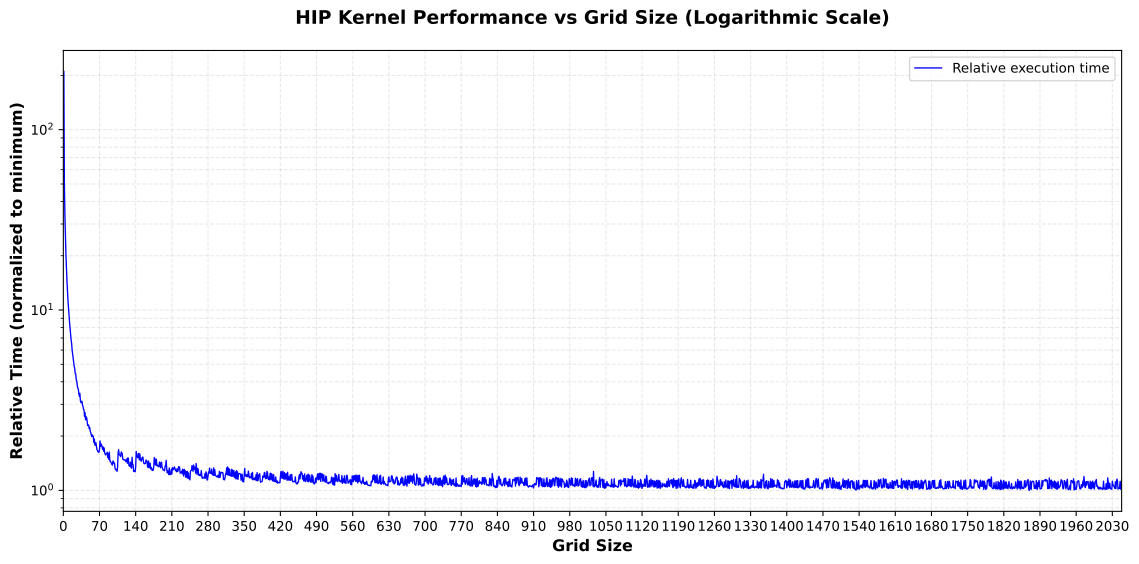
Impact of grid size on image gamma program performance. The execution time is measured based on a 16,384 × 16,384 RGB image on a Radeon PRO W7800 GPU.#
These measurements were taken on a Radeon™ PRO W7800 GPU using a 16,384 × 16,384 RGB image. The GPU has 35 work-group processors (WGPs), and each WGP can execute up to 32 wavefronts concurrently.
At a high level, you observe three major trends:
The performance improves as the number of workgroups increases because when there is a small number of workgroups, only a fraction of the compute units are used.
The performance saturates around 1,400 workgroups, which provides approximately 10× oversubscription of the Radeon PRO W7800 GPU’s capacity of 1,120 maximum concurrent wavefronts (35 WGPs × 32 wavefronts). This oversubscription is necessary for effective latency hiding in this memory-bound kernel.
A zig-zag pattern of execution times appears in the figure above. Sudden increases occur after multiples of 35. Given 35 workgroups, each WGP executes one workgroup in parallel; hence, they will likely finish at the same time. A few extra workgroups would not fully overlap with the first 35, but they would significantly increase the kernel execution time. This happens because although the last set of remaining workgroups might not be able to entirely utilize the GPU, they still have to do the same amount of work as the first set of workgroups. This effect, which is known as the tail-effect, is more pronounced when you have small grid sizes and should be avoided, if possible.
Key takeaways for optimal grid sizing#
The experiment demonstrates that a fixed-sized kernel can effectively optimize embarrassingly parallel implementations. When selecting grid sizes for your kernels, consider the following best practices:
Choose the smallest grid size that can fill all WGPs (RDNA GPUs in WGP mode) or compute units (RDNA GPUs in CU mode and CDNA GPUs) of the GPU.
Always use a grid size that is a multiple of the WGP or CU count to avoid the tail-effect.
Aim for sufficient oversubscription (approximately 10× in this example) to enable effective latency hiding in memory-bound kernels.
Test different grid sizes empirically, as optimal values may vary based on the specific GPU architecture and workload characteristics.